Biometrics vs. Keycards: Which Access System Survives the Nigerian Environment Best?
You’ve seen it happen: a humid Monday morning in Ikeja, a queue of employees at the front door, and a card reader that refuses to beep. Or perhaps it’s a high-end apartment in Lekki where the fingerprint scanner is struggling to read a thumb because of the afternoon dust.
In Nigeria, choosing a security system isn’t just about the latest tech; it’s about what can survive the "triple threat" of intense heat, pervasive dust, and inconsistent power. If your access control fails, your operations stall, and your security is compromised.
The Reality of the Nigerian Environment
Before we compare the hardware, we have to look at the "stress tests" our environment provides. From the salt air of Victoria Island to the harmattan dust of the north, our climate is notoriously tough on sensitive electronics.
A system that works perfectly in a temperature-controlled office in London might glitch within six months in a Lagos warehouse. Reliability isn't a luxury—it's a requirement for any serious business owner or facility manager.
Biometric Systems: The High-Tech Frontier
Biometric systems—using fingerprints, facial recognition, or iris scans—are becoming the standard for modern Nigerian offices. They offer a level of "unclonable" security that physical cards simply can't match.
Advantages of Biometrics in Nigeria
The biggest "pro" is accountability. You cannot "buddy punch" a fingerprint. This is why the biometric attendance system price in Lagos is often seen as an investment in productivity rather than just a security cost.
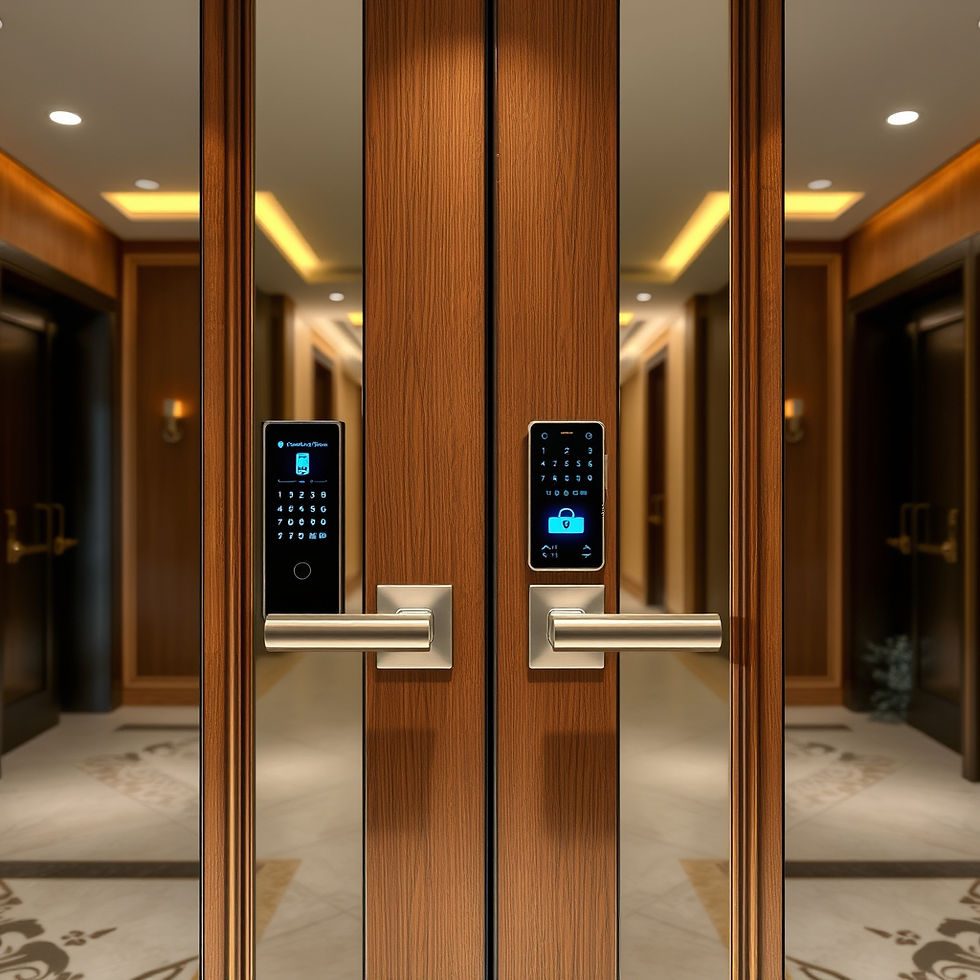
Furthermore, a fingerprint door lock with mobile app control allows business owners to manage access remotely. You can grant entry to a technician or a new hire from your smartphone while sitting in Lagos traffic, removing the need for physical key handovers.
The Environmental Challenge for Biometrics
Dust is the enemy of the optical sensor. In Nigeria, fine particles can settle on the scanner glass, leading to "false rejects." Similarly, high humidity can cause internal condensation in low-quality models. To survive here, you need sensors with an IP65 rating or higher, specifically designed for outdoor or semi-outdoor use.
Keycard Systems: The Rugged Veteran
RFID (Radio Frequency Identification) cards and fobs have been the backbone of security for decades. They are simple, familiar, and relatively cheap to replace.
Why Keycards Still Win on Durability
Keycard readers are often more environmentally resilient than biometrics because they don't require a clear "view" of a finger or face. The internal components are usually completely sealed in resin, making them virtually waterproof and dustproof.
If you are managing a construction site or a manufacturing plant where workers' hands might be soiled or calloused, a keycard is often more reliable than a fingerprint scanner.
The Downside: The "Lost Card" Tax
While the readers are durable, the cards are easily lost, stolen, or shared. This creates a recurring cost and a security gap. While the initial hardware might be cheaper than a fingerprint door lock with mobile app control, the long-term management of physical cards adds up.
Cost Comparison: Initial vs. Long-Term
When looking at the biometric attendance system price in Lagos, many buyers are surprised to find the gap between biometrics and card systems has narrowed.
Feature | Biometric System | Keycard System |
Initial Hardware Cost | Higher | Lower |
Maintenance | Sensor cleaning required | Minimal |
Recurring Costs | Zero (no cards to buy) | High (replacement cards) |
Nigerian Durability | Moderate (model dependent) | High |
For a luxury residential project, the
residents pay for high-end biometric sets is often justified by the increased property value and convenience. For a large factory with 500+ staff, a card-based system might still be the most rugged choice.
Power Considerations: The "NEPA" Factor
No security system survives in Nigeria without a power strategy. Whether you choose biometrics or cards, your system must be integrated with a reliable UPS or an inverter system.
Biometric systems, especially those with facial recognition and Wi-Fi, draw more power than simple card readers. Ensure your installer accounts for the "idle" power draw so your backup batteries don't drain unexpectedly during a long blackout.
Which System Should You Choose?
Choose Biometrics If:
You need to track staff attendance and prevent time-theft.
You want the prestige and convenience of a fingerprint door lock with mobile app control.
Your environment is relatively clean (offices, pharmacies, luxury retail).
Choose Keycards If:
You have a very high volume of users (500+).
The environment is extremely dusty or involves manual labor.
You need the most cost-effective entry-level solution for a gated estate.


Comments